Couples Therapy in Salt Lake City
You’re not broken. You’re stuck in a cycle. Emotionally Focused Couples Therapy gives you a proven way out.

Most of the couples who call us already see a pattern. One pushes to talk, while the other shuts down. Then you end up fighting about the laundry, and you both know it really isn’t about the laundry.
EFT is built for that pattern. It doesn’t just hand you a script for arguments, it changes the cycle that’s underneath. According to a 2024 study of emotionally disconnected couples, partners who were still living together but emotionally checked out cut their relationship distress roughly in half after just 9 sessions of EFT, and the improvement held.
Ed is an Emotionally Focused Couples Therapy (EFCT) Supervisor. Candace has advanced training in EFT for couples and individuals. Between them they bring more than 40 years of clinical work.
It’s important to recognize that the fight about laundry was never really about the laundry. It’s a cycle. One partner pursues, while the other withdraws. That withdrawal makes the other person push harder, and the pushing makes them pull further away.
Ed puts it like this:
“Sometimes we fight about the silliest things that seem small, but these negative cycles can drive major disconnection. We’re not actually fighting about dishes or money. We’re fighting because the cycle itself has taken over.”
EFT goes after that cycle directly, instead of refereeing the surface argument. And once both of you can see the pattern, it becomes the two of you against the pattern instead of against each other.
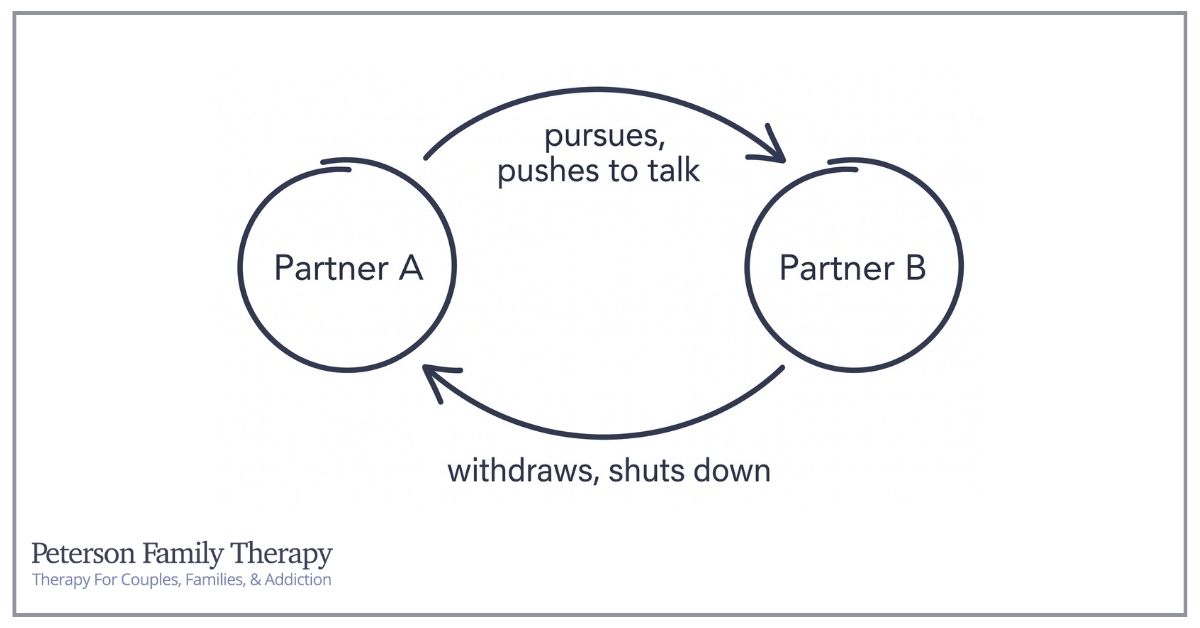
Ed describes what this cycle often looks like in the following hypothetical situation:
“Mary and Bill have been married for 10 years. Mary says Bill never talks about his emotions. Whenever things get uncomfortable, he walks away, goes to his phone, or says he doesn’t want to talk about it. She asks, ‘How was your day?’ and he says, ‘Oh, it was okay.’
The more Mary asks, and the more upset she gets, the more Bill withdraws.
Underneath both of their positions are attachment needs. Mary is more anxious in her attachment. She only feels better when she can lean in, find out what’s wrong, and talk it through. When Bill walks away, her anxiety and her nervous system go up, and she has a hard time calming herself.
Bill is more avoidant. When Mary asks him to tell her about his feelings, it makes him anxious, because a lot of times he doesn’t know. If she presses, he wants to pull back.
Here’s what neither of them sees. They are both fighting for the relationship. Mary is protesting: ‘I need my needs met, and they’re not being met.’ Bill pulls back because he’s afraid that if he stays in the conversation, he’ll say something he regrets.
She comes in. He goes out. And both of them end up feeling very far away from each other, with their needs unmet.”
That’s where EFT starts: helping both partners see the cycle for what it is, so they can stop fighting each other and start fighting it together.
Some couples feel like they need to wait until things are at a crisis level, but getting help earlier is almost always easier. Couples therapy is worth considering if any of these sound familiar:
If you’re facing a deadline or a decision about the relationship, our Marriage and Relationship Intensives compress weeks of work into a few focused days.

Lots of different approaches to couples counseling will focus on communication skills. EFT works on the emotional bond underneath how you communicate, by moving through 3 stages:
For couples recovering from an affair, the same stages apply. Rebuilding trust starts once the cycle has calmed enough for both of you to talk about the hurt without escalating things.
EFT asks both partners to be open and take emotional risks. That only works when both people are safe. Couples therapy usually isn’t the right starting point when:
If you’re not sure where your situation fits, ask us during your consultation. We’ll tell you honestly and point you to the right next step.
If you are in danger right now, call 911. For a mental health crisis, call or text 988.

EFCT Supervisor | Licensed by State of Utah / 8454347-3501
Ed has more than 20 years of experience and is an EFCT Supervisor, the credential that qualifies him to supervise other couples therapists. He was a founding partner at The EFT Clinic before starting Peterson Family Therapy with Candace.
“In two decades of practice, I’ve found that most couples aren’t broken. They are simply caught in a cycle of fear. My goal is to help you stop fighting the pattern and start reaching for each other again.”


Advanced Training in EFT for Couples and Individuals | Licensed by State of Utah / 4952015-3501
Candace has more than 20 years in mental health, including five years at the VA working with veterans and active duty military on trauma. That background shapes how she works with couples carrying old wounds into the relationship.
“I believe the answers to your relationship’s healing already live within you. My role is to provide the safety and guidance you need to express your deepest needs and rediscover the authentic connection you deserve.”

“My wife and I have been using Ed for the last four years, both separately and jointly. Ed has helped us through all sorts of seasons of life as well as a good mental health check up on a frequent basis.”
– Paul S.
“Ed was recommended to me by a friend and he has been great! I have done couples and individual therapy with him. He taught me a lot about internal family systems which has been very helpful in my growth. He is accommodating and responsive to my needs!”
– Alexa A.

Every person deserves a secure and loving bond. Our couples therapy honors your history, faith, and identity, and our office is a nonjudgmental, affirming space for:
Candace also facilitates a Religious Trauma Support Group at the Utah Pride Center. Learn more about our LGBTQIA+ affirming therapists.
Whether you’re in crisis or want to strengthen a relationship that’s mostly good, the first step is a conversation.
Call (801) 809-7990 or fill out the form below to schedule your consultation. We return calls, texts, and emails within one business day

How long does couples therapy take?
Most couples can see improvement within 8 to 20 sessions, but every relationship is different, and the timeline depends on what you’re trying to work through. We’ll talk about a realistic timeline during your consultation.
Do we both need to come?
It definitely helps when both partners are committed, but it’s common for one to be hesitant at first. Many reluctant partners settle in once they see that EFT doesn’t cast blame. If your partner isn’t ready to come at all, individual therapy in Salt Lake City can help you understand your side of the cycle in the meantime.
What if one of us isn’t sure about the relationship?
That’s common, and many couples start therapy while they’re unsure about whether they even want to stay together. EFT can help you get clarity either way, by reconnecting or by finding closure and understanding, if separating is the right choice.
We’re considering separation or divorce. Is it too late?
Plenty of couples come to us as a “last resort” and end up finding out they can reconnect in ways they never expected. Others leave with more clarity and closure.
Can couples therapy help after an affair?
Yes, many couples can rebuild their trust after infidelity, and EFT gives you a clear path to do it.
How much does couples therapy cost?
Our fees depend on the session length and the format. We’ll share the full fee breakdown during your consultation before you commit to anything.
Is couples therapy covered by insurance?
We’re an out of network provider, but can give you documentation you can submit for reimbursement if your plan covers out of network mental health care. We also accept HSA and FSA payments.
What happens in the first session?
We get to know you both, learn what brought you in, and start setting goals. We’ll ask about your history together and the pattern you keep landing in. Most couples leave the first session feeling heard.





 4505 Wasatch Blvd, #260